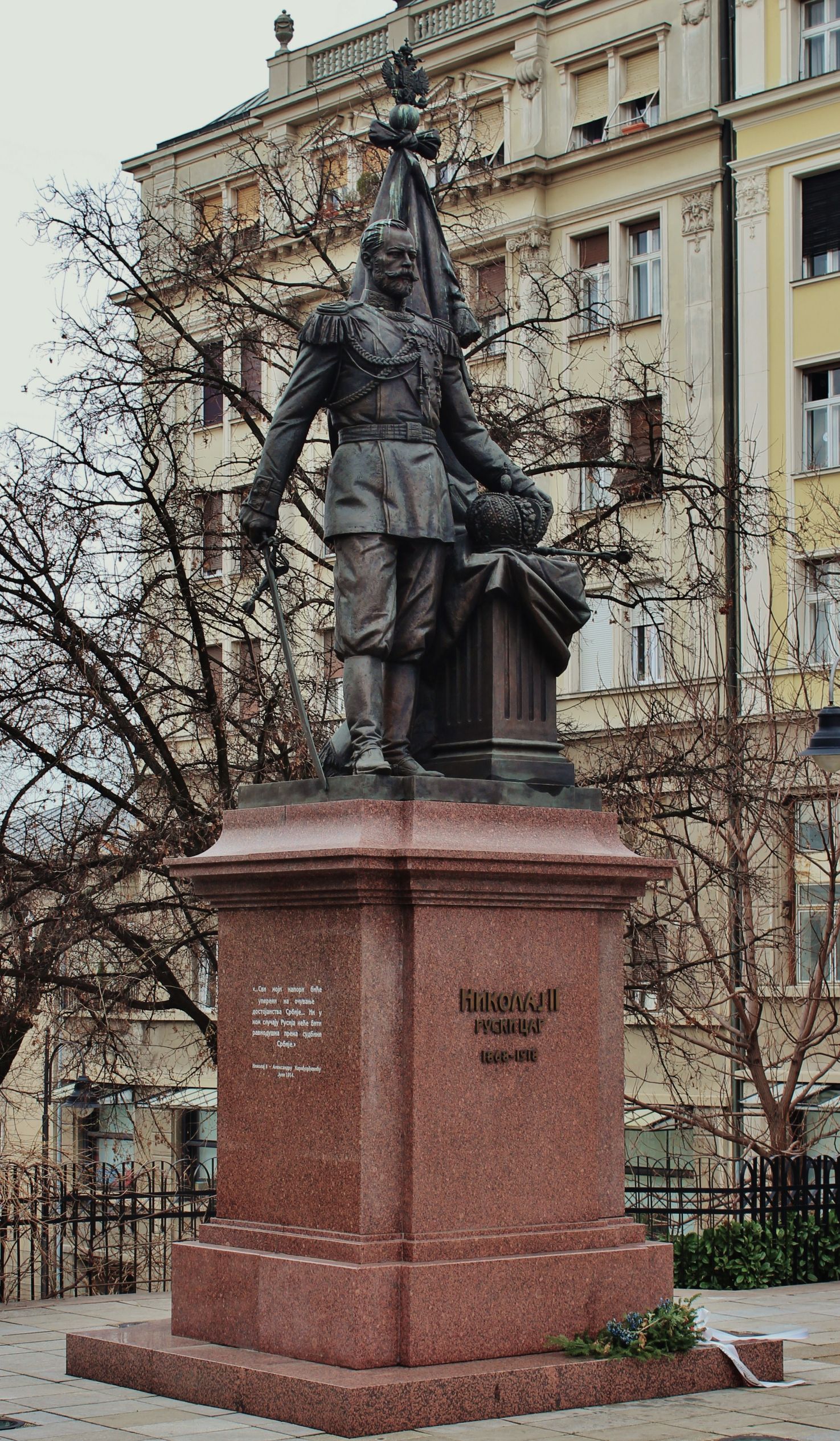
The monument to Russian Emperor Nicholas II Romanov (1868–1918) was unveiled on 16 November 2014 in Belgrade, in the park on Kralja Milana Street. The monument was a gift from the Russian Federation, supported by the Russian Military Historical Society, and was erected during the period of government led by the SNS, which maintains close relations with the Russian Federation. It was officially unveiled by the then President of Serbia, Tomislav Nikolić.
The ceremony was attended by Serbian Patriarch Irinej, Patriarch Kirill of Moscow and All Russia, representatives of the Government of Serbia, as well as officials of the Russian Federation and the City of Belgrade. The monument was created by Russian sculptors Andrey Kovalchuk and Gennady Pravotorov.
In the public space of Serbia, Nicholas II is most often portrayed as the ruler who supported Serbia in 1914 following the Austro-Hungarian ultimatum, thereby contributing to Russia’s entry into the First World War. This interpretation emphasizes his role as a protector of Serbia and of Orthodox solidarity, which is why the monument is often seen as a symbol of the historical friendship between the two countries. The pedestal of the monument also features a quote from his letter to Regent Alexander Karađorđević from July 1914, in which Russia expressed its support for Serbia.
The former Devojački (Girl's) Park, where the statue of the Russian emperor is located, holds an exceptionally significant historical and symbolic position. This space carries particular historical importance, as the Old House (Stari konak), the site of the assassination of the Obrenović dynasty in 1903, was located nearby. It is also surrounded by some of the most important state institutions of Serbia, including the building of the Presidency of Serbia and the Belgrade City Assembly.
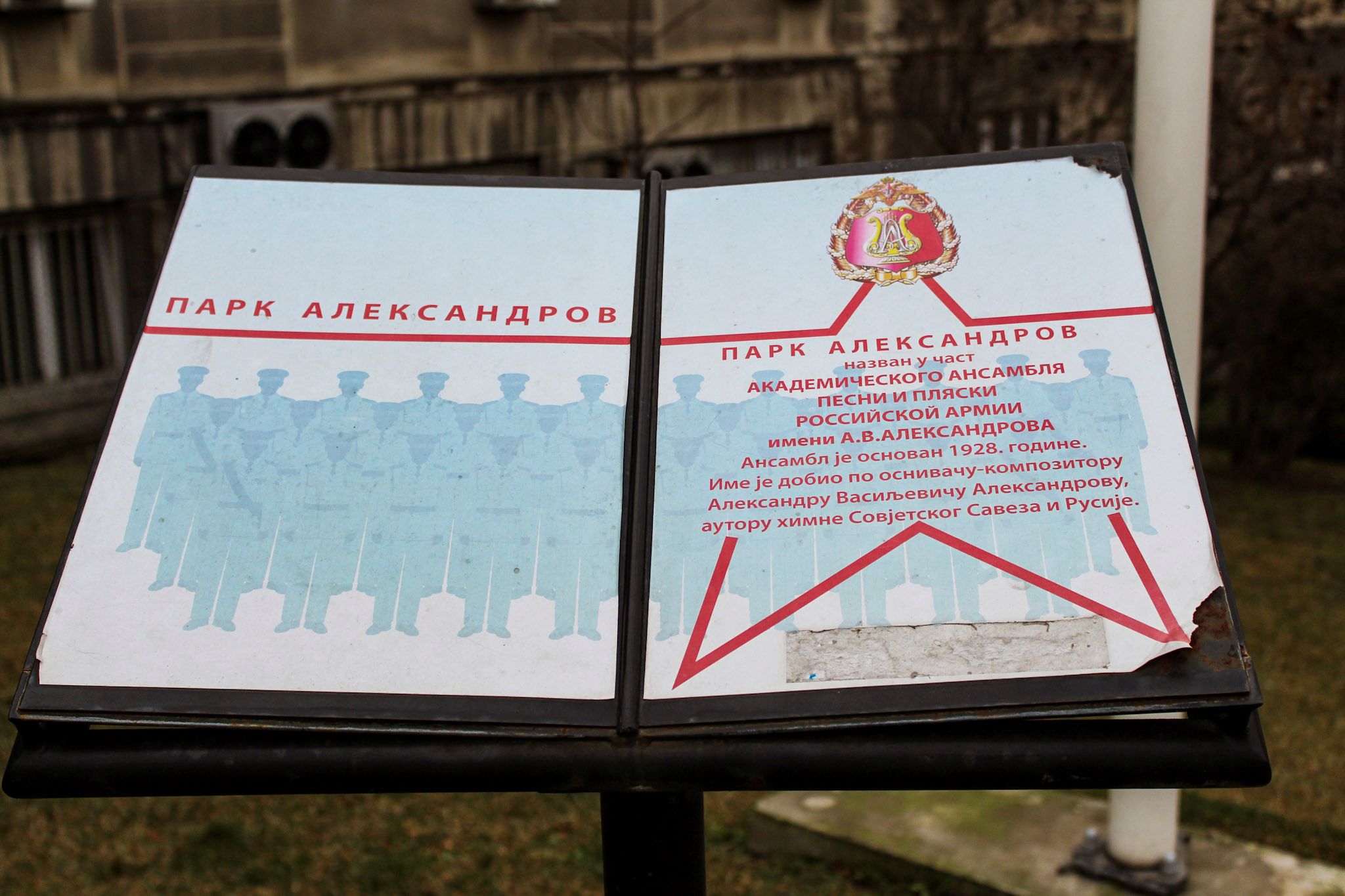
By a decision of the Belgrade City Assembly, the park was renamed Aleksandrov Park, in honor of the Alexandrov Ensemble, the Red Army Choir, many of whose members died in a plane crash over the Black Sea in 2016. The site also once housed the Embassy of the Russian Empire in the Kingdom of Serbia, which after the First World War became one of the centers of Russian emigration.
However, the historical figure of Nicholas II is subject to different and often conflicting interpretations. As the last Russian tsar, he ruled during a period marked by political crises, repression, and social unrest in Russia. His reign included events such as Bloody Sunday in 1905, the suppression of political protests, and limited reforms that failed to prevent growing dissatisfaction. After the October Revolution in 1917, Nicholas II abdicated, and in 1918 he and his family were executed.
The installation of the monument in Belgrade sparked public debate, as it highlights only one dimension of his historical role while overlooking controversies related to his rule in Russia. It has also generated controversy, particularly in light of the SNS-led government’s perceived alignment with and deference to the current Russian regime, raising questions about the political messages embedded in such commemorations.