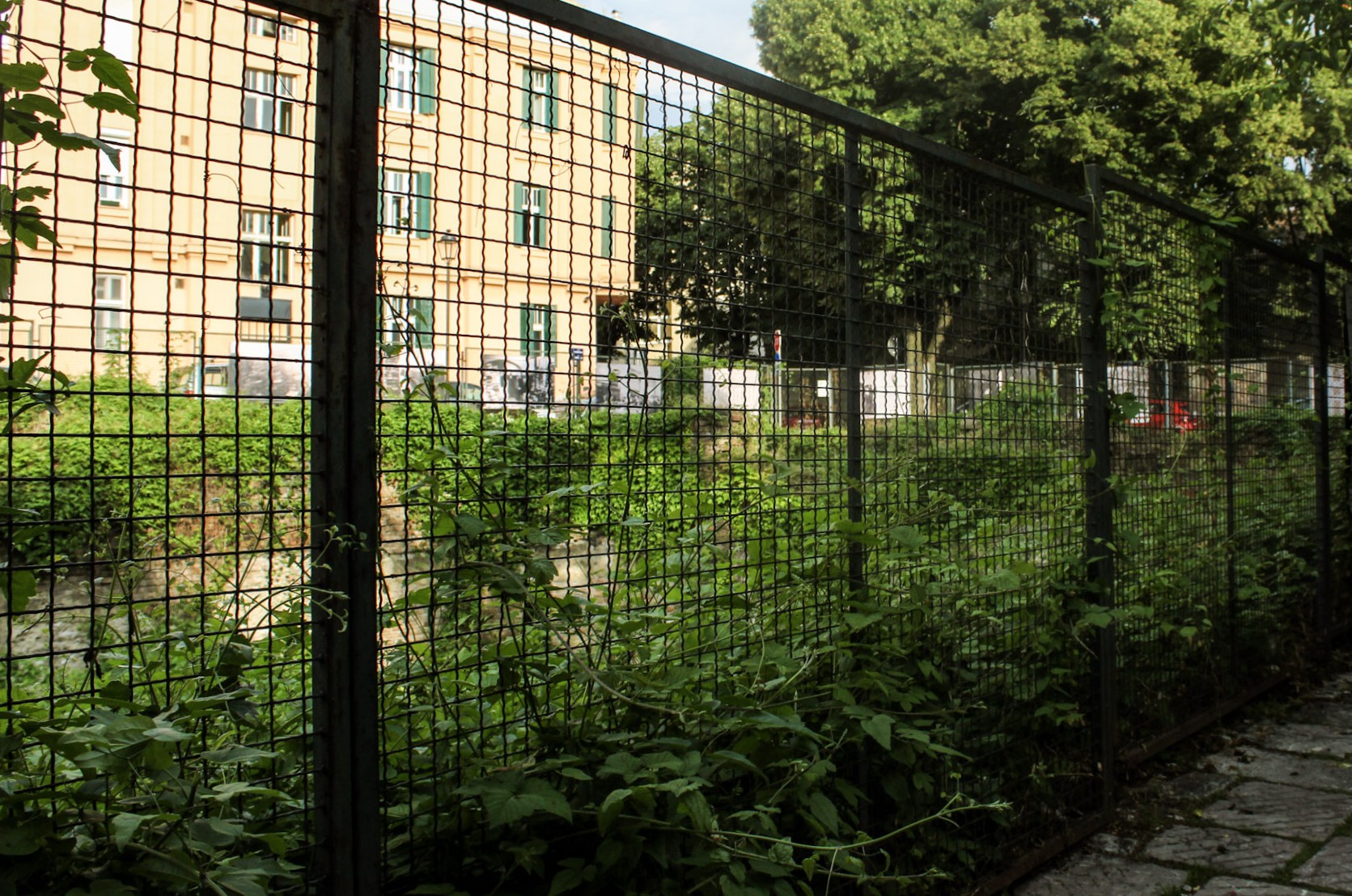
At Kosančićev Venac lies one of Belgrade’s most significant archaeological sites. Beneath today’s overgrown lot, layers have been preserved that testify to the city’s long history, from Roman Singidunum through medieval Belgrade and the Ottoman period, up to the era of the modern Serbian state, when the original National Library of Serbia was built on this site.
Yet the story of this site is not just about the city’s layers. It is also the story of one woman’s determination. Dr. Gordana Cvetković Tomašević, despite bureaucratic hurdles and limited funding, managed to ensure that scientific research took priority over administrative and urban pressures.
Archaeological investigations at Kosančićev Venac 12–16 began in 1976, aiming to systematically study the area planned for a memorial park dedicated to the former Library. The building had been bombed on April 6, 1941, by Nazi Germany, and during a third wave, it was hit by an incendiary bomb, causing a devastating fire. Almost all of the Library’s collections were lost in the blaze, representing one of the greatest cultural losses in Serbian history.
After the war, reconstruction proved impossible, and the remains of the building were removed, though the foundations and parts of the basement survived. The site, however, remained in ruins and unprotected for many years.
It was in these circumstances that Dr. Gordana Cvetković Tomašević initiated and led decades-long research, which, despite interruptions and modest funding, continued until 1997. Her persistent efforts revealed that Kosančićev Venac contained layers far older than the Library building itself. Beneath its foundations, remains of Roman baths were uncovered, confirming the urban character of this part of ancient Singidunum. In addition, medieval and Ottoman layers were documented, along with finds from more recent periods.
Throughout the investigations, nearly 1,100 movable objects were recorded, accompanied by extensive study documentation spanning from prehistory to the 20th century. This material has been entrusted to the Museum of the City of Belgrade.
The most significant and representative layer of the site belongs to the Roman period and is associated with the remains of a public bath (thermae) of ancient Singidunum. The complex was constructed at the end of the 2nd or beginning of the 3rd century, likely in connection with the activities of the Legio IV Flavia, whose stamps have been found on construction materials. The excavated area covers the central part of the building, approximately 800 m², while it is estimated that the entire complex occupied at least 2,000 m². Rooms with underfloor and wall heating systems (hypocaust), a frigidarium with a cold-water pool, and a caldarium with bathing tubs have been uncovered. Architectural decoration included wall frescoes imitating marble cladding, figurative and floral motifs, as well as mosaic floors.
The findings indicate that during the 4th century the building lost its original public function and was adapted for residential use, likely as an urban villa. Evidence for this includes a large number of ceramic, glass, and stone vessels for everyday use, household items, jewelry and personal care tools, as well as coins dating from the 1st to the 6th century. There are no signs of violent destruction; on the contrary, the layers of collapse and late Roman coins suggest a gradual abandonment of the building at the end of the 5th or beginning of the 6th century. In later centuries, construction materials from the ruins were reused in new buildings, while the layer of debris and soil preserved the remains of the ancient complex.
The youngest historical layer relates to the construction and destruction of the National Library of Serbia (along with two other houses), built at the beginning of the 20th century and destroyed in the German bombing on April 6, 1941. Excavations documented the layers of collapse and fire, as well as the remains of the burned library collections, thus archaeologically confirming and materializing one of the most dramatic episodes in Serbia’s cultural history.
Kosančićev Venac represents an exceptionally valuable, multi-layered urban archaeological complex, reflecting both continuity and interruptions of settlement from prehistory through the Roman and medieval periods to modern times.
Throughout the excavation period, there were initiatives to formally mark the site, but consensus was never reached due to differing interests. In 2011, a major initiative by Banka Intesa in Serbia was launched to restore the National Library memorial, with significant funds allocated. The project, however, was never realized for unknown reasons.
On the proposal of the City Assembly, a new design was prepared in 2017 by Slovenian architect Boris Podreka, but to this day, the project has not been implemented.