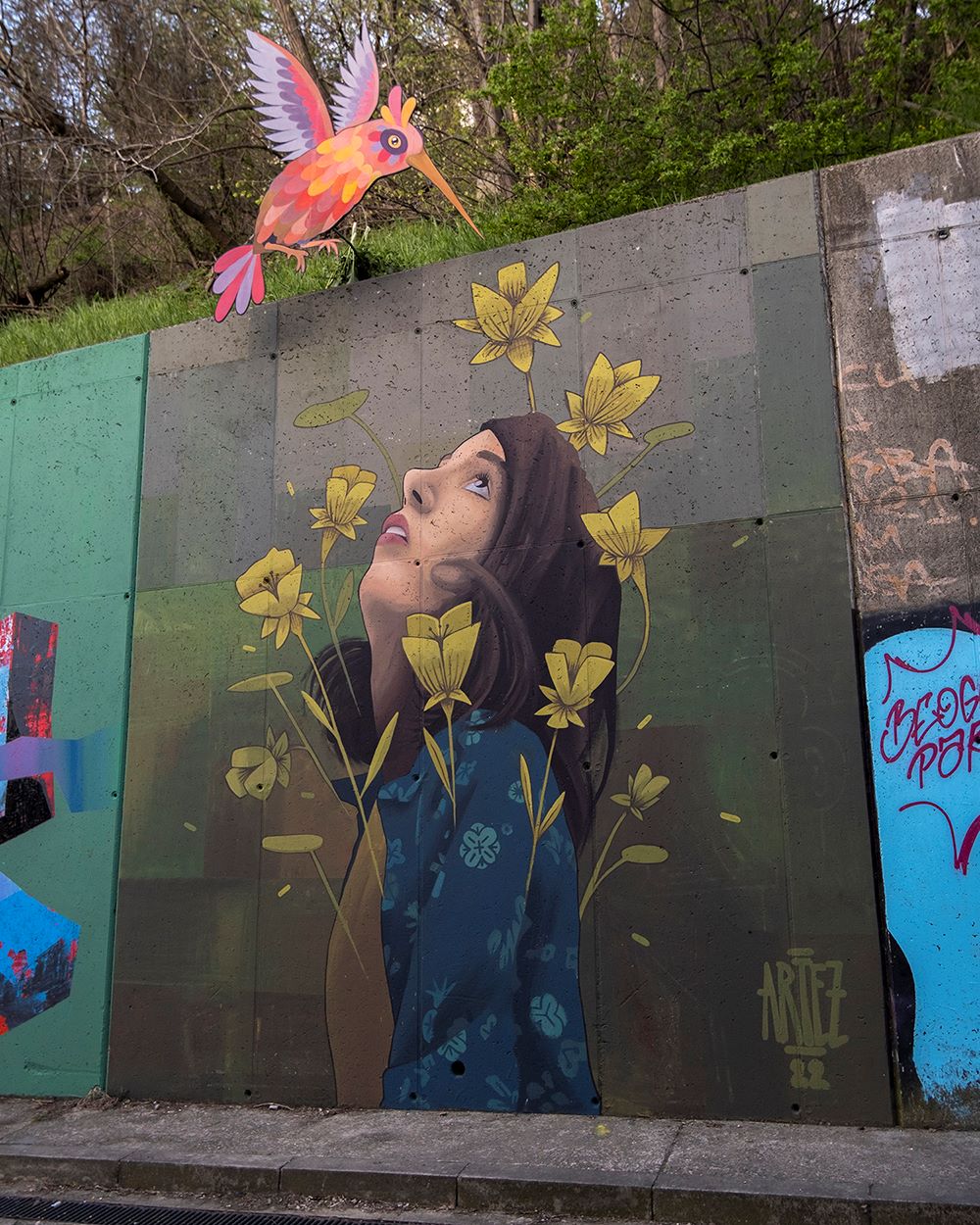
Andrej Žikić was born in 1988 in Belgrade. He graduated from the XIV Belgrade Gymnasium and obtained his degree from the Faculty of Architecture in Belgrade. His interest in graffiti emerged during high school, and he began building his career as a muralist after completing his studies. His early graffiti pieces could be found on the walls of the XIV Belgrade Gymnasium.
Zoja Andrijanić, a participant in our project, interviewed Artez, who portrayed her character alongside the boy Bogdan Stojković on the mural titled "One for Another." The mural is located in Borča and was created as part of the project by the organization Network of Psychosocial Innovations, aiming to integrate children without parental care from the migrant population with local youth.
Andrej Žikić, also known as Artez, an artist from Belgrade who travels around the world creating murals, how would you introduce yourself?
Considering that I recently decided to dedicate myself to personal development and my artistic expression, at this moment, I would introduce myself as Andrej Žikić, a first-year student at the Faculty of Fine Arts in Belgrade 🙂
How did you start painting murals?
I began working on large-scale wall paintings through hip-hop and graffiti culture, of which I was a passionate follower for over 10 years. At one point, I felt that writing letters limited me, and that's when the transition to mural painting began.
How challenging is your job?
Like any job, mural painting comes with its challenges. Besides being physically demanding at times, you also have to consider weather conditions, which are very common when working outdoors, whether it's high temperatures or cold accompanied by rain and snow. Additionally, frequent travels and separation from family and friends bring a sense of loneliness, which might be the most challenging aspect for me.
How do you choose subjects and motifs for your murals?
I mostly try to use photographs of people I know or find inspiring for my conceptual solutions. It's crucial for me to be the author of the photographs I use or know the person in them.
Do you have an interesting anecdote you can share with us?
During my travels in Argentina in 2016, I had the opportunity to meet a man who, for over 40 years since his parents passed away, hadn't had the chance to speak with anyone in his native language. He saw a report on local television about an artist from the Balkans painting a mural in their town and decided to come visit me. It was a touching conversation filled with tears and laughter, something I often fondly remember.
What are the biggest challenges in mural painting?
On one hand, the challenge lies in weather conditions combined with limited time for mural creation, while on the other hand, one of the greatest challenges is the human factor – the ability of the project organizers to provide comfortable and efficient support during the painting process.
Who were your influences when you started, and do you have any today?
Each phase is marked by an artist who served as inspiration at that moment, but I never aspired to draw identically to someone else. I think it's natural for people to admire the creativity of others and attempt to improve their artistic expression by observing their work, expressing their personal sensibility and identity.
What is the most interesting destination where you have painted?
If I had to choose one place, it would definitely be Madrid, primarily because of the life that constantly surrounds you in that city!
How many places in Belgrade feature your murals?
I couldn't give you an exact number, but I believe there are about twenty, probably more.
How would you describe the graffiti scene in Belgrade today?
The Belgrade graffiti scene is slowly but surely developing, both in terms of the number of artists and the scale of the painted walls. It's important to note that the street art scene in Belgrade is not only comprised of local artists but also receives a significant contribution from artists across Serbia who actively draw both at home and in the capital.
In your opinion, how important are graffiti and murals for Belgrade's cultural heritage?
There are numerous murals that already significantly contribute to the identity of our city and could become an essential part of Belgrade's cultural heritage. One of the most obvious examples is the now neglected mural by BLU in Pop Lukina Street. This work by the globally renowned Italian artist and one of the pioneers of street art worldwide is just one gem that our institutions, unfortunately, aren't even aware of.



Pripremila: Zoja Andrijanić